Tools & Software
Channel manager vs. iCal sync: when the switch pays off
iCal sync is free but slow, and a channel manager no longer changes most US hosts' Airbnb fee. Here's the math for deciding when software is worth paying for.

On this page
- Do you need a channel manager, or is iCal enough?
- How iCal sync works, and where the double-booking gap comes from
- What a double booking actually costs
- What a channel manager costs in 2026
- The break-even math: when software pays for itself
- How many iCal feeds you'd have to watch
- If you stay on iCal: a routine to narrow the gap
- Before you switch: five questions to ask any channel manager
- Your next step

If you list a rental on Airbnb and Vrbo, free iCal links can keep both calendars in step. The catch is timing: each platform pulls the other's calendar on a schedule, so dates booked on one site can stay open on the other until the next pull.
A channel manager is the usual fix, and in 2026 the money side of that choice changed. Airbnb's single 15.5% host fee had a September 15 deadline for hosts outside the European Economic Area (Airbnb Resource Center), so connecting software no longer changes the Airbnb fee for almost every US host. If you're new to hosting, start with what to buy and skip in your first 90 days.
Key Takeaways
- iCal sync is a scheduled pull: Airbnb imports other calendars every 3 hours, Booking.com every 2 hours and Vrbo every 30 minutes.
- A double booking mostly costs a cancellation fee, your time and status risk. The other guest's booking still pays for those nights, so you don't lose a whole stay's income.
- Connecting software no longer changes the Airbnb fee for almost any US host, because nearly every host outside the European Economic Area was on the single host fee by mid-September 2026.
- As an illustration, a $29-a-month tool breaks even at about 1.2 double bookings a year if each one costs a $300 fee. One unit on two channels with few bookings can reasonably stay on iCal.
- Before switching, check that the tool connects directly to every channel you use; Booking.com and Vrbo restrict iCal once connected software manages a listing.
Do you need a channel manager, or is iCal enough?
For one unit on two channels with modest booking volume, iCal plus a refresh-and-block habit is a reasonable choice. Software starts to pay when the double bookings you'd expect in a year would cost more than the tool, or when you have more calendar links than you can reliably check. In a BiggerPockets thread from about four years ago, one investor was willing to accept the risk because "we don't get very many bookings for this STR" (BiggerPockets).
With iCal, each platform gives you a calendar link ending in .ics, and every other platform imports it on its own schedule. A channel manager connects to each platform directly where it can and sends bookings and blocks to all of them. Vendors call that an API connection; Airbnb calls it "software that's integrated with Airbnb" (Airbnb Help Center).
How iCal sync works, and where the double-booking gap comes from
With iCal, each platform checks your other calendars at a set interval. Dates booked between checks stay open elsewhere until the next one.
- Airbnb: your calendar "automatically updates every 3 hours," and you can press Refresh sooner, but only a limited number of times (Airbnb Help Center).
- Booking.com: "Our platform automatically imports any connected calendar every two hours," and an Import now button updates it by hand (Booking.com Partner Hub).
- Vrbo: "Calendars sync every 30 minutes," and a refresh button lets you update sooner (Vrbo Help).
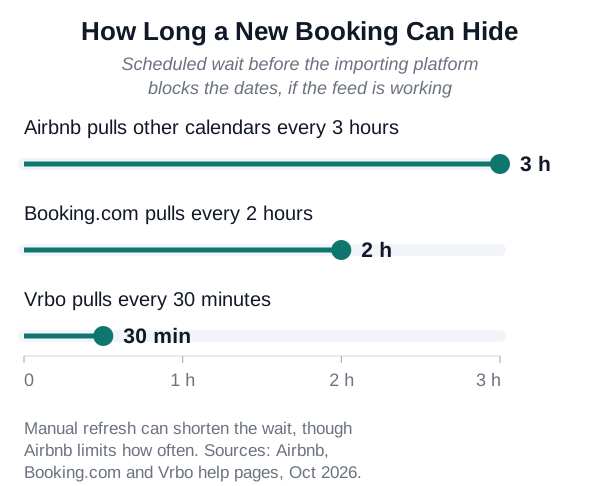
Booking.com spells out the result: sync "doesn't happen in real time," so reservations made elsewhere "might not sync right away, which can lead to double bookings" (Booking.com Partner Hub). Booking.com calls this rare, though the page gives no figure for how often it happens.
Airbnb blocks nights booked on a connected calendar, but nights you block elsewhere for prep time or advance notice "may or may not be blocked on Airbnb" (Airbnb Help Center). The link only shares taken dates, so set minimum-stay rules on each channel separately.
Hosts also report feeds that stop without warning. A host on the Airbnb Community forum wrote in 2024 that "the sync sometimes just stops working randomly," with each platform blaming the other. That's the riskier failure, because the dates look open until you notice the calendar's last-update time hasn't moved.
Which sync direction has the longest delay
Airbnb imports least often, so a Vrbo booking can take up to 3 hours to block your Airbnb calendar. An Airbnb booking should reach Vrbo within about 30 minutes, and bookings from either can take up to 2 hours to reach Booking.com. Even a 30-minute window leaves room for collisions: a post in the same 2024 thread describes an overbooking where the "Airbnb booking came at 10:36 pm, VRBO came at 10:39 pm."
What a double booking actually costs
On Airbnb, a cancellation you're responsible for costs at least $50 and up to half the reservation, and the policy lists "double-booking a Listing" as an example of host responsibility (Airbnb Help Center). The fee depends on how far before check-in you cancel.
- More than 30 days out. Airbnb fee: 10%. On a $1,200 reservation: $120.
- 48 hours to 30 days out. Airbnb fee: 25%. On a $1,200 reservation: $300.
- 48 hours or less, or after check-in. Airbnb fee: 50% of nights not stayed. On a $1,200 reservation: $600 before check-in.
The reservation amount includes the base rate, cleaning fee and any pet fees, but not taxes or guest fees. At 10%, any reservation under $500 hits the $50 minimum instead.
You get no payout for the canceled reservation, but the other guest's booking for those nights still pays you, which is easy to forget when you tally the damage. If the stays cover the same dates, your direct loss is the fee, your time and any help you give the canceled guest.
If the canceled stay ran five nights and only two overlapped, you also lose the three nights only that booking covered, and Airbnb may block those dates so you can't resell them there. And you can't nudge the guest into canceling: "A host may not encourage the guest to cancel the reservation" (Airbnb Help Center).
Airbnb also warns that hosts "may lose their Superhost status" (Airbnb Help Center), and Superhost requires "a less than 1% cancellation rate," checked every quarter over the past 12 months (Airbnb Help Center). If you had 100 or fewer reservations in that window, counting the canceled one, a single cancellation puts you at 1% or more.
On Vrbo, Rental Scale-Up's September 2025 coverage of the host cancellation policy lists similar 10%, 25% and 50% tiers by timing, plus 100% at check-in (Rental Scale-Up). Skift reported a 100% penalty from October 1, 2025 for US hosts who leave guests stranded (Skift).
What a channel manager costs in 2026
For one to five units, published prices run from $0 to $104 a month. The tools below are examples with public prices, not recommendations. Prices are as of October 2026 and can change.
- Hospitable Essentials. 1 unit, monthly: $0. 3 units, monthly: $0. 5 units, monthly: $0. Notes: Unlimited properties; all booking channels.
- Hospitable paid plans. 1 unit, monthly: $29 (Host). 3 units, monthly: $74 (Professional). 5 units, monthly: $104 (Professional). Notes: Host max 2 units ($39 for 2); Professional $59 for 2, then $15 each.
- OwnerRez. 1 unit, monthly: $40. 3 units, monthly: $70. 5 units, monthly: $88. Notes: $55 for 2; no setup or booking fees; 14-day trial.
- Hostaway. 1 unit, monthly: Not published. 3 units, monthly: Not published. 5 units, monthly: Not published. Notes: Quote form only.
Hospitable's prices and its $15-per-property dynamic pricing add-on come from its help page (Hospitable), which also says its Vrbo connection runs by API and is "available to hosts on all Hospitable subscription plans" (Hospitable). Compare the free tier's features with the paid plans before you rely on it. OwnerRez figures are from its live price calculator (OwnerRez); Hostaway's pricing page is a quote form (Hostaway).
Connecting software no longer changes your Airbnb fee
Under Airbnb's split fee, most hosts paid 3%, but the host-only fee is mandatory for "hosts who use property management software" (Airbnb Help Center). Rental Scale-Up reports that software-connected US and Canadian hosts moved to 15.5% on October 27, 2025 (Rental Scale-Up). In July 2026, Airbnb announced it was "combining both fees into a single 15.5% service fee paid by hosts," with a September 15 deadline outside the European Economic Area (Airbnb Resource Center).
Hospitable's help page says that as of September 17, 2026, Airbnb had moved "almost all hosts outside the European Economic Area" to the host-only fee (Hospitable). Airbnb's own help page still describes the switch as "in the process of transitioning all home hosts" (Airbnb Help Center). If your Airbnb payouts already show the 15.5% fee, connecting a channel manager won't change which fee you pay; what's left is the subscription and the setup time.
The break-even math: when software pays for itself
Divide a year of software by the cost of one double booking. That's your break-even: if you expect more double bookings a year than the result, and the tool connects directly to every channel you use, it pays for itself in cash; if fewer, iCal is cheaper.
One double booking's cost is the likely cancellation fee, plus any rebooking help you pay for, plus your time. The examples below count the fee alone, so they lean toward iCal. They're illustrations using Hospitable's prices and Airbnb's 25% tier on a $1,200 reservation, a $300 fee:
- One unit, $29 a month: $348 a year divided by $300 is about 1.2 double bookings a year.
- Three units, $74 a month ($59 plus $15 for the third unit): $888 divided by $300 is about 3.0.
- A $0 tier: the cash break-even is zero, so the choice rests on setup time and whether you want to manage listings through the tool.
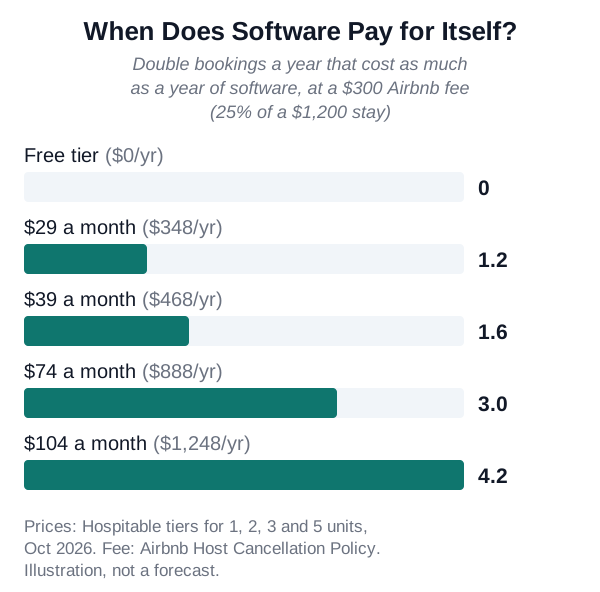
A collision on a stay starting within 48 hours falls in the 50% tier, $600 on the same reservation, and the $29 plan then breaks even at about 0.6 double bookings a year. That's why short-lead-time bookings carry the most cost risk. If the stays only partly overlap, add the income from any nights you can't resell.
Estimating your own double-booking risk
The missing input is how often double bookings happen. We searched platform help pages, Phocuswright, AirDNA, Key Data, Skift and academic databases and found no dataset that measures it, so any fixed unit-count rule is a guess. Your last 12 months of bookings, plus a few weeks of watching your feeds, are better evidence.
- Short-lead-time bookings: same-day or next-day stays, which land in the 50% tier if they collide.
- Near misses: bookings or inquiries for overlapping dates on different channels within 3 hours of each other.
- Stale feeds: how often an imported calendar on Airbnb shows a last update more than 3 hours old.
Then compare what you find with your break-even number. If you're new, 2026 US occupancy and rate benchmarks give a rough sense of how full a calendar gets.
How many iCal feeds you'd have to watch
With iCal, every channel imports every other channel's calendar for each unit, so the feeds to keep working equal units x channels x (channels minus 1). One unit on two channels has 2 feeds, and a third channel triples that to 6. Five units on three channels have 30, and ten have 60.
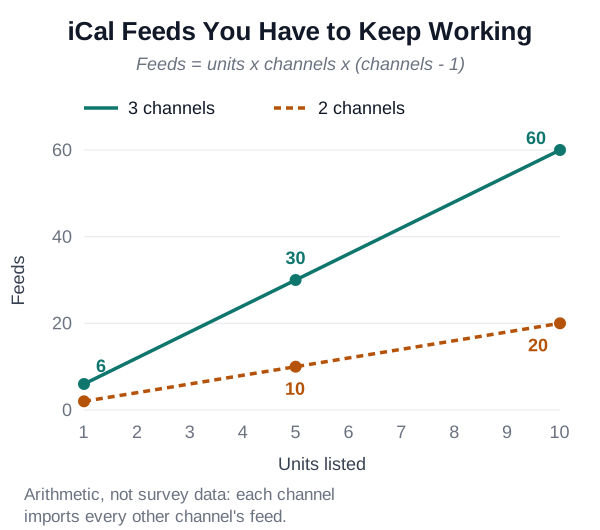
The second trigger is the attention all this takes. A refresh habit only catches a dead feed if you check it. Two feeds are easy to watch; 30 make a standing weekly chore, and any feed you skip can fail unnoticed.
If you stay on iCal: a routine to narrow the gap
A host on the Airbnb Community forum described a common approach in 2024: "I think most Hosts (without a channel manager) accept the risk and refresh the Airbnb calendar after every booking and manually block the opposite calendar until the sync catches up." These steps turn that into a routine.

- After every booking, check that the dates are blocked on each other channel. If not, refresh that calendar (Refresh on Airbnb, Import now on Booking.com) or block the dates by hand.
- Set prep and turnover days on each channel yourself. The same 2024 thread notes you "have to manually block days before/after a booking on Vrbo."
- Once a week, check the last-update time Airbnb shows for each imported calendar (Airbnb Help Center). If one is more than 3 hours old and still hasn't updated after the next automatic update, delete and re-add the link.
- Consider turning off Instant Book, or lengthening advance notice, on the channel that imports slowest. A host in a 2017 Airbnb Community thread did just that on Airbnb. Longer advance notice keeps out the same-day bookings that land in the 50% tier if they collide.
- If a double booking happens, act the same day. Airbnb's fee depends on how far before check-in you cancel, so waiting can push you from 10% to 25%, or from 25% to 50%.
Before you switch: five questions to ask any channel manager
A channel manager only replaces the iCal schedule on channels it connects to directly. Ask these before you move a listing.
- Does it connect directly to every channel I use? A channel reached through iCal still imports on its own schedule. One investor on BiggerPockets noted about three years ago that OwnerRez documents "what limitations API has with each particular OTA" (an OTA is a booking site such as Airbnb or Vrbo) (BiggerPockets).
- Can I keep iCal as a backup? Not everywhere. Booking.com lists "You don't use a Connectivity provider" as a condition for calendar sync (Booking.com Partner Hub), and Hospitable notes that "Booking.com only allows one connectivity method at a time" (Hospitable). Vrbo says "You cannot import calendars if your property is managed through third-party property management software" (Vrbo Help).
- Where will I edit prices and blocks? Once connected, you manage listings through the tool, so be sure you're happy working there.
- Can I move one unit first? A one-listing trial shows how bookings and blocks flow before you commit every unit.
- What will it cost at next year's unit count? Plans step up with units, and Hospitable's Host plan stops at two properties.
Your next step
Two numbers decide this: a year of software against the cost of the double bookings you'd likely face, and how many feeds you can realistically watch. Pull your last 12 months of bookings, count your channels and short-lead-time bookings, and run the break-even with your own cancellation fee and the software price you'd actually pay. If you switch, add the subscription to the "Fixed costs per year" field in the return on investment calculator.
Common questions
How often does Airbnb sync with Vrbo?
Airbnb imports connected calendars every 3 hours and Vrbo every 30 minutes, according to each platform's help page. Both allow a manual refresh, though Airbnb limits how often. Without one, a Vrbo booking can take up to 3 hours to block your Airbnb calendar.
Can iCal sync cause double bookings?
Yes. Dates booked on one channel stay open on the others until their next import, and Booking.com's help page says delayed sync "can lead to double bookings." A feed that stops working leaves dates open until you notice.
Is a channel manager worth it for one property?
It depends on your booking volume. With one unit on two channels and few bookings, a refresh-and-block routine is a reasonable choice. At a $300 fee, a $29-a-month plan pays for itself at about 1.2 double bookings a year, and a $0 tier that covers your channels takes cost out of the decision.
Does connecting a channel manager change my Airbnb fee?
Not for almost any US host now. Airbnb's switch to a single host-paid fee, 15.5% for most hosts, had a September 15, 2026 deadline for hosts outside the European Economic Area, and Hospitable reports almost all had moved by September 17. Airbnb set October 13, 2026 as the deadline for hosts in the EEA and Switzerland.
Sources
Read next
Regulations & Licensing
Short-term rental permit requirements: how to check yours
Cina ·
Pricing & Revenue
Minimum stay settings: when to hold firm and when to bend
Cina ·
Guest Experience
How to handle a guest noise complaint before neighbors call the city
Cina ·


