Pricing & Revenue
Minimum stay settings: when to hold firm and when to bend
A minimum stay decides which searches you show up in and which gaps you can fill. Here's when a longer one protects revenue, and when it just leaves nights empty.

On this page
- What a minimum stay actually does to your calendar
- Most hosts in big U.S. markets use one minimum stay all year
- When a longer minimum protects revenue
- When a minimum just kills off-season bookings
- Is this one-night booking worth taking? A four-question test
- Airbnb, Vrbo and pricing-tool settings that do the work for you
- A starting schedule to adapt, not copy
- When the minimum isn't yours to change
- Your next step

Your minimum stay is one of the few short-term rental settings that changes both who can find your listing and which nights you can sell. Set it high and you protect weekends and cut turnovers, but you miss short searches and strand nights between bookings. Set it low and the trade reverses.
Below: when a longer minimum pays, when it just empties your off-season, and a four-question test for deciding whether one night is worth taking. For the wider market picture, see our 2026 U.S. occupancy and pricing statistics.
Key Takeaways
- A minimum stay controls which searches you appear in and which gaps you can fill. The right number changes with the season, the weekday and how far out the date is.
- AirDNA found that 60% of hosts in the 50 largest U.S. markets use the same minimum stay every night of the year.
- Take a one-night booking when it won't cost you a longer stay and it clears your turnover cost with room to spare.
- Minimums apply by check-in date, so a one-night weekday rule can let a Thursday guest book into your weekend.
- Some minimums exist to meet local, HOA or building rules. Those aren't yours to tune.
What a minimum stay actually does to your calendar
A minimum stay decides which guest searches your listing can appear in and which calendar gaps can ever be filled. That makes it a visibility setting as much as a cost setting.
Expedia Group tells Vrbo hosts that "if a traveler is searching for a three-night stay and your minimum stay requirement is four nights, your property will not show up in that traveler's search results" (Expedia Group). Airbnb's host guide agrees: "Changing your trip length can open your calendar and help your listing appear in more search results" (Airbnb).
The cost side pulls two ways. Set the minimum too low and you pay turnover costs more often per night sold, and a short stay can split dates a longer booking wanted. Set it too high and you strand orphan nights that no guest is allowed to book. Airbnb even flags this: "if your minimum length of stay is 5 nights and you have 4 unbooked nights between reservations, you'll see a tip to lower your trip minimum for those nights" (Airbnb).
Most hosts in big U.S. markets use one minimum stay all year
AirDNA's May 2026 analysis found that 60% of hosts in the 50 largest U.S. markets use the same minimum stay every night of the year, rising to 64% in major urban markets (AirDNA). A single number can't fit a July Saturday and a January Tuesday alike.
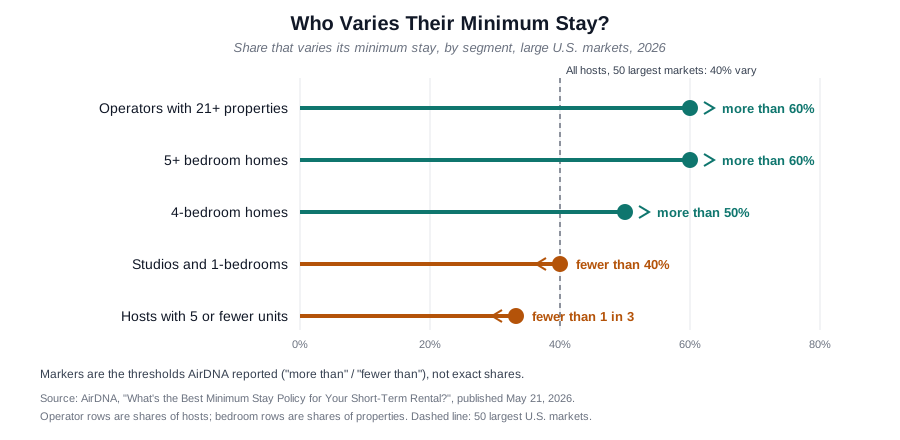
In the same data, more than 60% of operators with 21 or more properties vary their minimum, against fewer than one in three hosts with five or fewer units. Bigger homes vary more too: more than 60% of homes with five or more bedrooms do, against fewer than 40% of studios and one-bedrooms.
When a longer minimum protects revenue
A longer minimum earns its keep when a long booking is likely to show up and a short one would get in its way. That usually means peak season, holidays, event weekends and dates months away, when a longer booking still has time to come in.
Weekends are the other case. AirDNA's September 2026 analysis of U.S. check-ins, which doesn't state its date range or sample size, found that 49% of Friday check-ins are two-night stays leaving Sunday, and another 23% stay three nights (AirDNA). A one-night Friday booking in season blocks the most common weekend stay and can leave Saturday stranded.
The Thursday check-in leak
Minimums are checked against the day a guest arrives, not each night of the stay. Vrbo's help center says "the minimum night stay requirement is based on the check-in date," and gives an example: with a one-night minimum Monday to Thursday and a three-night minimum Friday to Sunday, "a guest could book their stay to start on Thursday and only book one or two nights" (Vrbo Help Center).
In AirDNA's check-in data, 38% of Thursday arrivals stay three nights and another 21% stay four, "so roughly 60% of Thursday arrivals run through the weekend" (AirDNA). With a one-night Thursday rule, a guest can book just Thursday and Friday instead. That leaves Saturday hard to sell, since a three-night weekend minimum makes a Saturday arrival stay until Tuesday.
When weekends sell, the fix is to make a Thursday arrival cover Saturday night: a three-night Thursday minimum. Airbnb's "Customize by check-in day" setting lets you create rules "for each day of the week (ex: 2 nights minimum for Friday check-in vs. one night minimum for all other days)" (Airbnb Help Center). That example leaves Thursday at one night, which is exactly where the leak happens. On Vrbo, set date-specific minimums for the Thursdays that matter.
When a minimum just kills off-season bookings
In slow months, a minimum that made sense in July mostly produces empty nights. The long booking it was protecting isn't coming, and the short ones that would have come can't get in. AirDNA makes the point with Hilton Head, a beach market where July Saturdays book week-long stays. By January, "a seven-night Saturday minimum doesn't fit a month where only 15% of Saturday arrivals book exactly a week" (AirDNA).
More of the bookings that do come arrive late. PriceLabs' January 2026 trends report says bookings made 0 to 7 days before arrival are now 27% of all reservations, up from 21% in 2021. The window for January stays fell from 19 days in 2022 to 15 in 2026 (PriceLabs). A minimum that never relaxes as dates get closer blocks exactly those bookings.
Orphan nights are the other cost. PriceLabs, which sells gap-filling software, puts the blame on the host: "The gap is not caused by weak demand. It is caused by your own settings, which is why it is fixable" (PriceLabs). A host on the Airbnb Community forum said much the same: "A lot of shoulder-night gaps are minimum-stay problems as much as price problems" (Airbnb Community).
Airbnb's own low-season advice points to the fix: "you might choose to allow one-night stays during the middle of the week but not when guests book a Friday or Saturday night" (Airbnb). That opens midweek without exposing your weekends. If you do open one-night stays, set clear house rules first. Our guest noise complaint protocol covers what to do if one goes wrong.
Is this one-night booking worth taking? A four-question test
Take the one-night booking if it won't cost you a longer stay and it clears your turnover cost with room to spare. A night that's close in, or stuck between two bookings, usually passes. A far-out night in the middle of an open stretch usually doesn't.
1. How far out is the date?
Inside about a week, a longer booking has little time left to find those dates. Months out, it still has time. Your own booking lead time by season tells you where "close" starts.
2. Does it fill a gap or split a stretch?
A single open night between two bookings can't hold a longer stay, so taking it displaces nothing. A night in the middle of five open nights turns one bookable stretch into two short ones your own minimum may block. One host on the Airbnb Community forum drew the line by timing: "1 night is good for last minute (last week) bookings" (Airbnb Community).
3. What does it actually net?
Here's an illustration, not market data. Say your nightly rate is $150, you charge a $90 cleaning fee, and each turnover costs you $70 in cleaning, laundry and supplies. On Airbnb's split fee, most hosts pay 3% of the nightly price plus cleaning fee (Airbnb Help Center).
- One night: $150 + $90 = $240. The 3% fee is $7.20. Net: $240 minus $7.20 minus $70 = $162.80.
- Three nights: $450 + $90 = $540. The 3% fee is $16.20. Net: $540 minus $16.20 minus $70 = $453.80, or about $151 a night.
On the single fee, where most hosts pay 15.5% (Airbnb Help Center), the same stays net $132.80 and $386.30. In this example the cleaning fee covers the turnover either way, so the real cost of a one-night stay is what it displaces. If your cleaning fee is below your turnover cost, or you offer Airbnb's lower short-stay cleaning fee, the one-night net drops and the case for taking it weakens.
Then check what the booking displaces. Say the one-night guest wants the middle night of an open three-night stretch, and the nights on either side then go unsold. You're trading a sure $162.80 for a chance at $453.80. Saying no only pays if a three-night booking is more than about 36% likely to land on those dates ($162.80 ÷ $453.80), or about 34% on the single fee.
The real bar for saying no is higher than that, because the nights on either side might still sell as short stays. Run your own numbers through the cleaning fee calculator before you decide.
4. If you say no, what will the calendar look like in two weeks?
Check how similar dates filled in past seasons. If they were still open this close to arrival, the longer booking probably isn't coming, and the one-night guest is your real demand. If they usually filled with longer stays, hold.
In AirDNA's check-in data, Saturday is "the only day of the week where one-night stays are the most common length, at 27% of Saturday arrivals" (AirDNA). So a Saturday one-nighter may be real demand rather than a leftover gap.
Quick verdicts by situation
- One open night between two bookings: Displacement risk: None. Verdict: Take. Why: No longer stay fits, so it sells as one night or not at all.
- Off-season midweek, within a week: Displacement risk: Low. Verdict: Take. Why: A longer booking has little time left to arrive.
- Saturday off-season, or with Friday already booked: Displacement risk: Low. Verdict: Take. Why: One-night stays are Saturday's most common length.
- Saturday in season, Friday still open: Displacement risk: Medium to high. Verdict: Take if close-in, decline if far out. Why: It can strand Friday, and 49% of Friday arrivals stay two nights.
- Friday in season: Displacement risk: High. Verdict: Decline. Why: It can strand Saturday and blocks the most common weekend stay.
- Far-out date in peak season: Displacement risk: High. Verdict: Decline. Why: A longer booking still has time to find those dates.
- Holiday or event night: Displacement risk: High. Verdict: Decline, or raise the minimum. Why: These are the dates longer stays compete for.
Airbnb, Vrbo and pricing-tool settings that do the work for you
Both platforms, and pricing tools such as PriceLabs, let you build this test into your calendar so you don't have to run it by hand.

On Airbnb, two settings go beyond the check-in-day rules above. The first is a custom trip length for specific dates: "Adding a custom trip length that's shorter than your minimum trip length for certain dates can help you fill gaps in your calendar" (Airbnb). The second is a short-stay cleaning fee, which lets you offer "guests who book 1 or 2 nights in your listing a lower cleaning fee than the standard cleaning fee" (Airbnb Help Center).
On Vrbo, you can override the minimum for specific dates (Vrbo Help Center). One host on BiggerPockets reported that a three-night minimum on Vrbo's settings page still let two-night bookings through on a June weekend. The host said Vrbo support told them date-range values on the calendar take precedence (BiggerPockets). That's one host's account, not Vrbo's documentation, so check the minimum on the calendar dates themselves.
Pricing tools can apply gap rules for you. PriceLabs' help center describes an adjacent-day setup: a three-night minimum on the first night after a booking and 7 or 99 nights on the second, so a short stay can't start the day after a checkout and leave one empty night behind (PriceLabs Help). PriceLabs' default also discounts gaps of two nights or less by 20% (PriceLabs). Both are PriceLabs' own settings, not market data.
A starting schedule to adapt, not copy
Start from how your market books, then relax the minimum as dates get closer and in slow months. Check what similar listings near you require and how your own past guests booked, season by season.
Here's one way to layer it. The numbers are an illustration, not a recommendation for your market:
- Season baseline: three nights in peak season, two in shoulder months, one in the off-season.
- Weekend rule: Friday check-ins at two nights or more, and Thursday check-ins at three when weekends sell, so a Thursday arrival covers Saturday.
- Distance rule: keep the seasonal minimum for dates months away, then drop to one or two nights inside the last two weeks.
- Gap rule: allow any stay that exactly fills a gap between two bookings.
Review the schedule each season against what booked. If your listing is new, start with our guide to a new listing's first ninety days, and check the occupancy you need with the break-even occupancy calculator before you tighten anything.
When the minimum isn't yours to change
Some minimums exist because a local rule, a building or an HOA requires them. AirDNA found that in some large U.S. cities, local short-term rental rules push many operators toward mid-term rentals, with a large share of listings requiring stays of 14 nights or more (AirDNA). They're compliance settings, and they stay put whatever demand does.
Airbnb's own guidance is to "make sure your minimum and maximum trip lengths follow local rules and regulations" (Airbnb). A host on the Airbnb Community forum, for example, set a 30-night minimum to meet a local bylaw (Airbnb Community). This article doesn't cover what any particular place requires, so check your local rules, HOA or building rules, and lease first.
Your next step
Hold the minimum where a longer booking is still likely, and relax it where the only demand left is short. To start, open the next 60 days of your calendar and look for nights your own minimum has stranded: single nights between bookings, a lone Saturday after a short Thursday stay, two-night gaps under a three-night rule. Then run the cleaning fee calculator at your one-night numbers to see what a single night really nets you.
Common questions
What is a good minimum stay for an Airbnb?
There's no universal number. In AirDNA's data, roughly 40% of listings in the largest urban, mountain and lake markets run a static one- or two-night minimum, and about 20% in the largest beach markets a static three- to seven-night minimum (AirDNA). Use your market's norm as a starting point, then vary it by season and weekday.
Do one-night stays attract parties?
Airbnb has named stay length as one party-risk signal, but it doesn't ban one-night stays. It screens higher-risk entire-home bookings over U.S. holiday weekends, including July 4, 2026 (Airbnb Newsroom). Its summer 2025 notice said the system was designed to help identify and prevent "certain attempts to book one-to-two-night stays in entire home listings that could be higher risk for a disruptive party" (Airbnb Newsroom), and its Halloween 2025 notice listed "the length of the reservation" among its signals (Airbnb Newsroom). Your own safeguards still matter, starting with clear house rules and a look at who's booking. If something does go wrong, our guest noise complaint protocol (linked in the off-season section above) covers what to do.
Does a lower minimum help my Airbnb search ranking?
Airbnb talks about visibility, not ranking. Its help center says "the more flexibility a host offers around how long guests can stay, the more likely the listing will work with the guest's plans and show up in search results" (Airbnb Help Center). A lower minimum lets you appear in short-stay searches you were filtered out of, but Airbnb doesn't say it moves you up the results.
What is an orphan night?
An orphan night is an open night, or short run of nights, between two bookings that's shorter than your minimum, so no guest can book it. The fix is to allow a shorter stay on just those dates. Airbnb shows a tip in cases like 4 open nights under a 5-night minimum (Airbnb), and pricing tools can do it automatically.
Sources
Read next
Pricing & Revenue
US short-term rental occupancy, ADR & RevPAR statistics (2026)
Tra Ly ·