Automation & Operations
Guest bed bug report: a host's response protocol
Two branches, one requirement: what to do when a guest reports a bed bug bite versus an unconfirmed sighting.

On this page
- The first message back matters more than the first hour
- Two different situations that call for two different responses
- How to read a bite photo, and what it can't tell you
- Case A: what comes next when the guest has bite marks
- Case B: what comes next with a suspected sighting and no bites yet
- What Airbnb, Vrbo, and Booking.com actually require from hosts
- The documentation that protects you either way
- If the inspection confirms an infestation
- If the inspection finds nothing
- Conclusion

Key Takeaways
- Acknowledge the report and name a concrete next step in your first reply. Don't argue about cause and don't promise a refund before an inspection.
- Bite appearance alone cannot confirm bed bugs. Marks can take up to 14 days to appear, and some people never show a mark at all (CDC, retrieved 2026-09-23).
- Case A (a documented bite) and Case B (an unconfirmed sighting) both require the same licensed inspection. What changes is documentation and communication, not the inspection step itself.
- Get the pest control provider's finding in writing on company letterhead either way. It's the single document that protects you whether the inspection is positive or negative.
- None of Airbnb, Vrbo, or Booking.com publish a dedicated bed bug policy; each routes a report through general cleanliness or guest-safety standards, with different evidence thresholds.
A guest messages you with a photo of red welts and the word "bed bugs" in the subject line. Or a guest messages you saying they "think" they saw something moving near the headboard but nothing has bitten them yet. Those are two different problems, and treating them the same way either overreacts to a maybe or underreacts to real evidence.
This guide splits the response into two explicit paths: Case A, a guest who reports an actual bite, often with a photo, and Case B, a guest who reports a suspected sighting with no bite yet. Both paths converge on the same requirement, a licensed pest control inspection, but what you document and how you communicate differs between them. It also covers how to read a bite photo without over-trusting it, what Airbnb, Vrbo, and Booking.com actually require from hosts, and the single document that protects you regardless of which way the inspection goes.
Getting the basics of a new listing right in the first place (the equipment and setup decisions that head off complaints like this one) is covered in RentalWe's first-90-days guide.
The first message back matters more than the first hour
Don't argue about cause, don't promise a refund before you've investigated, and don't go silent while you figure out next steps. Your first reply should do three things: thank the guest for flagging it, state plainly that you're taking it seriously, and name one concrete next step with a timeframe ("I'm booking a licensed pest inspection for [date] and will update you as soon as I have results").
What not to say in that first message:
- Don't accuse the guest of bringing the bugs in, even if you privately suspect it. You don't have evidence yet, and an accusatory tone is what turns a manageable report into an escalated dispute.
- Don't deny anything before you've had a professional look. "That's not possible, we just cleaned" is a promise you can't back up yet.
- Don't leave the message unanswered for hours while you decide what to do. Guests read silence as stonewalling.
The written report itself matters beyond the immediate conversation. Whatever the guest sends you, ideally through the platform's messaging system rather than a side channel like text or email, becomes part of the record the platform will reference if the guest escalates. That's true whether the inspection later confirms an infestation or clears the property. Treat the first reply as something you'd be comfortable having a platform reviewer read later, because it might be.
Two different situations that call for two different responses
A guest with visible bite marks, possibly a photo, is not the same case as a guest who says "I think I saw something" with nothing on their skin. Conflating the two either overreacts to an unconfirmed report or underreacts to documented evidence.
Case A: the guest reports being bitten. They have marks, and often a photo. This case moves faster: request platform-based photo documentation, book the inspection promptly, and consider offering alternative accommodation while you wait on results.
Case B: the guest reports a suspected sighting or itchiness with no clear evidence yet. No bite, no photo, sometimes just "I saw something dark near the mattress." This still warrants a real inspection: you can't dismiss it on the guest's say-so any more than you should treat it as confirmed. But the urgency and the tone of your communication differ.
Both cases still require the same professional inspection before you conclude anything either way. What changes between them is what you document and how you talk to the guest in the meantime, not whether you inspect.
How to read a bite photo, and what it can't tell you
Bite appearance alone cannot confirm bed bugs. The CDC notes that reactions range from no physical signs at all to small bite marks to, rarely, a serious allergic reaction. Bed bugs inject an anesthetic and an anticoagulant when they bite, so the guest often doesn't feel it happening (CDC, "About Bed Bugs," retrieved 2026-09-23).
Typical bed bug bites show up as small red or slightly swollen welts, commonly arranged in a line, a cluster, or a zigzag pattern, often in groups of three to five (Harvard Health, retrieved 2026-09-23). That pattern is a useful clue. It's also exactly why bites get misdiagnosed: Harvard Health notes they're commonly mistaken for mosquito bites, flea bites, spider bites, or a plain rash or hives. The marks themselves can be random rather than patterned in some people.
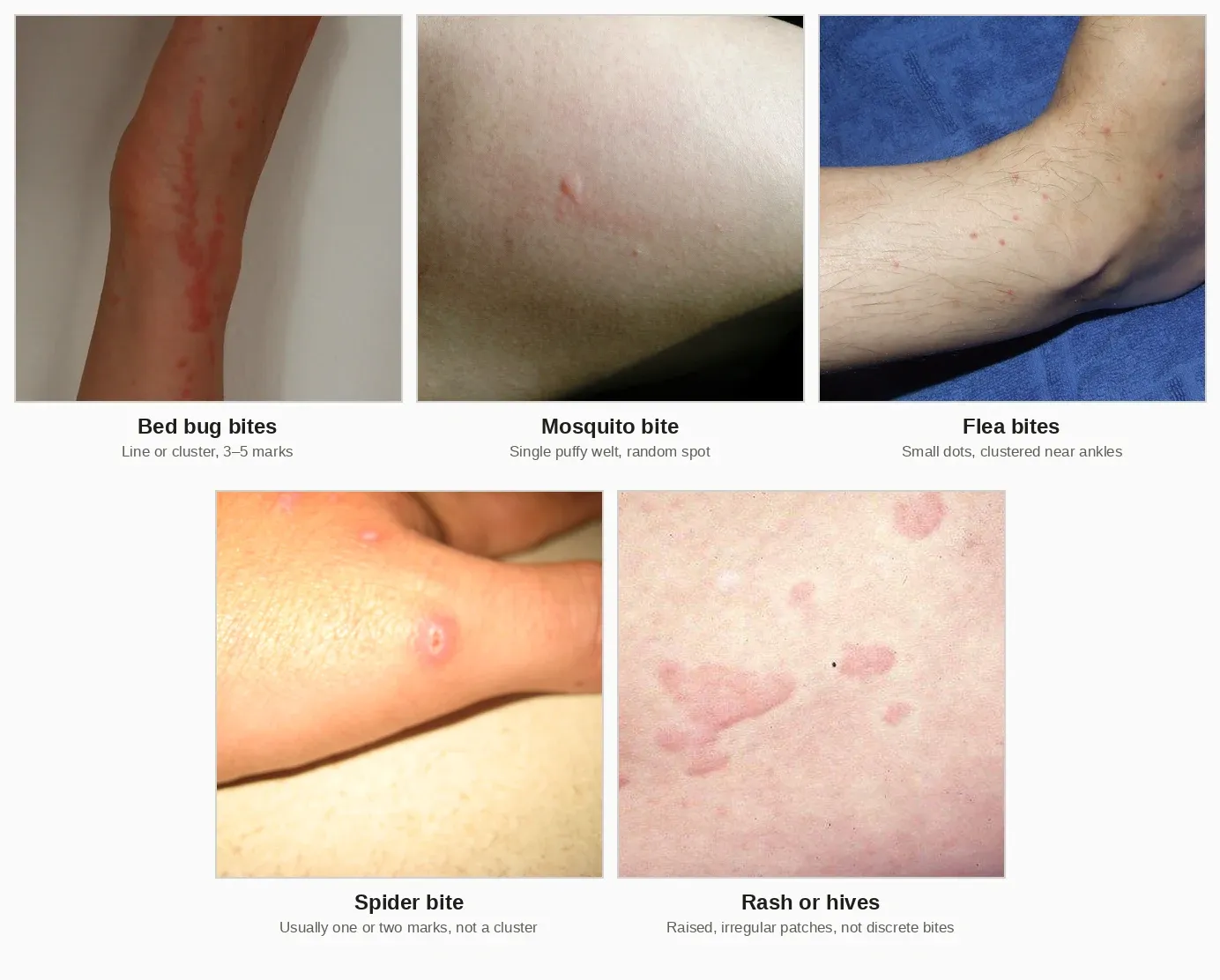
The timing makes photo evidence even less reliable on its own. Both the CDC and Harvard Health note that a bite mark can take up to 14 days to appear after the actual bite, and some people never develop a visible mark at all. A guest photographing a fresh welt on checkout day may be looking at something that happened well before their stay, or a reaction to an entirely different insect.
Because a photo of a mark can't settle the question, look past the skin for corroborating physical evidence. That means shed exoskeletons (the shell a bed bug leaves behind as it grows), live bugs in mattress or sheet folds, and rust-colored spots on the mattress or nearby furniture from crushed bugs or droppings. Heavier infestations often add a sweet, musty odor (CDC, retrieved 2026-09-23). None of that is something you or the guest can reliably assess from a phone photo. It's what a licensed inspector is checking for.
Photo checklist to ask the guest for
If a guest sends a bite photo, ask for a fuller set rather than relying on the single skin close-up:
- A close-up of the bite cluster itself, in focus.
- A wider shot showing where on the body the marks are.
- If they're willing, a photo of the bedding, mattress seams, or headboard area, not just the skin. This is the shot that's actually diagnostic, since it's where an inspector would look first.
Send this request through the platform's messaging system so the photos become part of the same documented thread as everything else.
Case A: what comes next when the guest has bite marks
Don't self-diagnose from the photo, and don't let the guest's confidence about the cause set your response. Schedule a licensed pest control inspection and let that finding, not the photo, drive what happens next.
Request photo documentation through the platform's own messaging tools rather than text or personal email, so there's a timestamped record tied to the reservation. Book the inspection as soon as a licensed provider can get to the property.
One host account on BiggerPockets described exactly this sequence. A guest claimed a bite with no specimen available to confirm the species. The host deep-cleaned, found what looked like possible casings and excrement but nothing conclusive, called an exterminator, and offered the current guest a hotel while waiting on results (BiggerPockets, "Bed Bugs Protocols as Host", retrieved 2026-09-23).
Offering the current guest alternative accommodation while you wait on the inspection is a reasonable step that doesn't concede fault. It's a service gesture, not an admission. What it does do is take the pressure off a same-night decision about refunds or cause.
Hold off on canceling upcoming bookings until you have a confirmed result. That's a decision the inspection should drive, not a preemptive move based on one guest's report. If the inspection does come back positive, the calculus changes fast (more on that below).
Case B: what comes next with a suspected sighting and no bites yet
An unconfirmed report still gets a real inspection. It just doesn't carry the same urgency, or the same refund pressure, as a documented bite.
Don't dismiss a guest who says "I think I saw something" just because they don't have a bite or a photo. Inspect the unit anyway.
A cabin owner on BiggerPockets described a case that ran the other direction from what you might expect. A guest sent a bite photo that didn't actually match reference images for bed bug bites. The owner called their regular monthly pest control contractor, and the inspection turned up only one old bed bug skin that predated the current ownership, with over 200 guests staying since and no other reports (BiggerPockets, "Bed Bugs in Vacation Rental Accusation", retrieved 2026-09-23). That's essentially a negative result: one stale, unrelated trace, not an active infestation.
While the inspection is pending, respond to the guest in a way that neither concedes the point nor dismisses it. Something like: "I take this seriously and I've scheduled a licensed inspection for [date]. I'll share the findings as soon as I have them." That's honest, concrete, and doesn't promise an outcome you don't control yet.
What Airbnb, Vrbo, and Booking.com actually require from hosts
None of the three major platforms publish a dedicated, standalone bed bug policy. Each one routes a report through its general cleanliness or guest-safety standards instead, and each sets a different bar for what counts as evidence (Turno, "Airbnb, Vrbo & Booking.com Bed Bug Policies Explained", published 2022-04-04, retrieved 2026-09-23). Airbnb's own current host guidance backs this up directly. Its ground rules require a listing to be "free of health hazards (mold, pests, etc.)" and to meet "a high standard of cleanliness." Guests are directed to document any issue "using the Airbnb message thread, photos, etc." before requesting a refund through the Resolution Center (Airbnb Help Center, "Ground rules for home hosts", retrieved 2026-09-23).
How Airbnb, Vrbo, and Booking.com compare:
- Airbnb. Investigated under Airbnb's cleanliness guarantee. Can temporarily suspend a listing until the host proves professional treatment. Evidence it accepts: photos of bugs at mattress edges or cushions, photos of eggs or droppings, or medical documentation of bites.
- Vrbo. Treated as a listing-accuracy issue. Needs proof the stay was materially affected; repeated complaints risk suspension or delisting. Evidence it accepts: guest-submitted evidence tied to the specific stay.
- Booking.com. Scored through the platform's 1-10 guest cleanliness rating. Hosts scoring below 6.0 risk deranking or possible suspension. Evidence it accepts: guest reviews and cleanliness ratings feeding the score.
The common thread across all three: they expect a prompt host response, licensed pest control involvement (not a DIY spray-and-hope), and dated documentation you can produce if the platform asks. Hospitable.com, a property management software vendor, adds that Airbnb specifically suspends a listing until the issue is resolved. It also says platforms in general require proof of professional extermination before they'll let a suspended listing reopen for bookings (Hospitable.com, "Airbnb Bed Bugs Problem," retrieved 2026-09-23).
This is general information about how these platforms currently describe their own processes, not legal advice, and platform policies change. The summary above reflects Airbnb's own current Help Center language, plus Turno's April 2022 reporting and Hospitable.com's current help content for the comparative detail Airbnb's own pages don't spell out. Before an active dispute, it's worth reconfirming the specifics directly against each platform's own current help center rather than treating this comparison as a permanent reference. If a dispute escalates past what a documented, good-faith response resolves, that's a good point to loop in the platform's own support process directly rather than negotiate the outcome yourself in guest messages.
The documentation that protects you either way
The single highest-leverage document in a bed bug dispute is a dated statement from your pest control provider, on company letterhead, regardless of which way the inspection goes.
Don't settle for a verbal "looks clean" from the technician on their way out. Ask for it in writing. The top-voted reply in one BiggerPockets host thread put the advice in almost exactly the words you want on the page. Get a note reading close to "We treat this property monthly. We have inspected the property and have found no signs of bedbugs," and send it to the platform through its own messaging system (BiggerPockets, "Bed Bugs in Vacation Rental Accusation", retrieved 2026-09-23). The same thread's advice: once that documentation exists, stop open-ended back-and-forth with the guest and redirect further conversation to platform support. Stay willing to offer a refund if it's genuinely warranted. The goal isn't to stonewall a reasonable guest. It's to stop relitigating a question the inspection already answered.
Keep dated turnover logs and prior inspection records on file even when nothing's wrong. A single report lands very differently for a platform reviewer when you can show a pattern of regular, documented pest control versus when this is the first time pest control has ever been mentioned for the property.
Once you have a written finding, route any continued guest disagreement through the platform's messaging and support channels rather than an extended private negotiation. That keeps the documented record, the one the platform will actually look at, intact.
If the inspection confirms an infestation
A confirmed result changes the math. You're no longer resolving one guest's stay. You're likely looking at several days of lost-booking turnover cost while treatment happens.
Refund or relocate the reporting guest, and notify the platform proactively rather than waiting for the guest to escalate to support first. Cancel and rebook the affected upcoming reservations through the platform's own tools. In practice, the platform is likely to freeze your calendar once a confirmed report reaches them anyway, so getting ahead of it costs you less flexibility than being forced into it.
On treatment method, practitioner discussion on BiggerPockets frames it as a real tradeoff between speed and cost. Heat treatment can clear an infestation, including eggs, in a single pass, but it costs more upfront. Chemical treatment is cheaper, but it typically needs reapplication and a longer clearance window before the unit is safely bookable again (BiggerPockets, "Bed Bugs Protocols as Host", retrieved 2026-09-23). The same thread's reasoning for leaning toward heat when you can afford it: dragging out treatment with repeated chemical rounds extends the window where a future guest could still carry bugs home and hold you responsible for it.
Get the platform's required proof of professional treatment in hand before you reopen the calendar. Reopening early, before you can document the treatment, risks the exact repeat-complaint scenario that gets listings deranked or suspended.
If the inspection finds nothing
A negative inspection doesn't end the conversation. It just changes what you're documenting.
Share the letterhead finding with both the guest and, if the report was made through the platform, the platform itself. Consider a partial goodwill gesture if the stay was genuinely disrupted for the guest, even when the inspection didn't find an infestation. That's a judgment call about the guest experience, not an admission that bed bugs were present.
A review that states bed bugs "were" present, written after a negative inspection, is a specific and awkward situation. Don't argue the point inside the review response itself; a public back-and-forth rarely reads well to other prospective guests. Instead, rely on your documented case (the letterhead statement, the dated inspection record, the messaging history) and raise it through the platform's own review-dispute or support process, where the actual record can be evaluated.
Conclusion
Whichever case you're facing, the same four moves hold: acknowledge the report without arguing about cause, get a licensed professional inspection regardless of which case it is, let that inspection, not the photo, drive your decision, and get the finding in writing on letterhead either way. The two paths only diverge on urgency and tone; the inspection and the documentation habit stay constant.
Bed bug reports are stressful precisely because they touch money, your calendar, and your reputation all at once. A calm, documented, inspection-led process is what keeps a single report from turning into a lost week of bookings or an unresolved dispute.
For general guidance on getting your host operations right from day one, see RentalWe's Getting Started guide.
Common questions
How fast do hosts need to respond to a bed bug report?
Acknowledge the report the same day it comes in, even if you don't have an inspection scheduled yet. From there, book a licensed inspection as soon as a provider is available. One documented host account on BiggerPockets describes contacting an exterminator the same day a guest reported a bite, though actual availability depends on your local providers.
Can a host ask for photo evidence before offering a refund?
Yes. Airbnb, Vrbo, and Booking.com all expect the host and guest to work through some documentation before a claim is resolved, and asking for platform-submitted photos is a reasonable, non-accusatory first step. That said, if a guest escalates directly to platform support, the platform may act on its own timeline rather than waiting on your investigation.
Does a single bite report mean the property has an infestation?
No. Bite appearance alone doesn't confirm bed bugs: reactions vary widely and marks can take up to 14 days to appear, per the CDC and Harvard Health. Real host cases on BiggerPockets include reports where a bite photo didn't match reference images and the resulting inspection came back essentially negative.
Is heat treatment or chemical treatment better?
It depends on your urgency and budget. Heat treatment can clear an active infestation, eggs included, in one visit but costs more. Chemical treatment is typically cheaper but needs reapplication and a longer window before the space is safely bookable again.
Will a bad review get removed if bed bugs were never confirmed?
Not automatically. Your best path is documenting the negative finding on pest control letterhead and raising the review through the platform's own dispute or support process rather than debating it in a public reply.